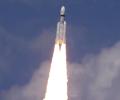
Currently, some of the rocket hardware for the human space programme has reached the Satish Dhawan Space Centre in Sriharikota and the integration of the crew module was going on at the Vikram Sarabhai Space Centre, Trivandrum, ISRO chairman S Somanath said.

On Friday, July 14, India launched its ambitious third lunar mission Chandrayaan 3, eyeing a rare feat in moon exploration.
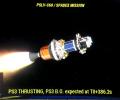
Dubbed as a prelude to ISRO setting up its own Space Station by 2035, the PSLV-C60 mission would also make India join an elite club in achieving this feat which is expected to take place in the coming days.

On Sunday, July 30, 2023, the Indian Space Research Organisation successfully launched its proven Polar Satellite Launch Vehicle rocket carrying seven Singapore satellites from the Satish Dhawan Space Centre in Sriharikota and placed them into intended orbits.
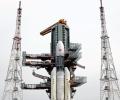
India's second moon mission Chandrayaan-2 is all set to be launched on board Indian Space Research Organisation's most powerful rocket GSLV-Mk0III-M1 from Satish Dhawan Space Centre in Shriharikota.

ISRO stated that the disengagement of at least one contact -- in both the main and redundant paths -- of a connector led to the failure of NVS-02.
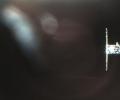
The Indian Space Research Organisation (ISRO) on Sunday said the two satellites launched to perform space docking experiments were brought within three metres and then moved safely back in a trial attempt.

The polar satellite launch vehicle's 52nd mission is scheduled for lift-off at 15.41 hours on Thursday from the second launch pad at the spaceport of Sriharikota 'subject to weather conditions'.

India is set to take its first steps towards its own human space flight when the uncrewed Gaganyaan mission soars to the skies later this year. Private players in the space sector are also gearing up for launching satellites on home-built rockets.
The Indian Space Research Organisation will open 2025 scoring a century orbiting the country's navigation satellite 2,250 kg NVS-02 with its rocket Geosynchronous Satellite Launch Vehicle (GSLV)-F15.
The mission is targeted for launch in the fourth quarter of 2024.
If it becomes a reality, the Chennai-based company will become the first private player from India to conduct such a mission to the lunar surface.

SpaceX's Falcon-9 rocket was scheduled to blast off from the Kennedy Space Centre in Florida on Tuesday evening.
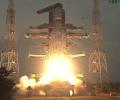
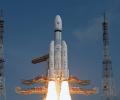
The heaviest communication satellite to be launched from the Indian soil onboard a new generation, homegrown 'Bahubali' rocket was successfully placed into the intended orbit on Sunday, the Indian Space Research Organisation said.

AzaadiSAT had around 75 small payloads developed by schoolgirls of 75 rural schools.
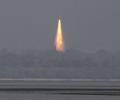
Indian Space agency Indian Space Research Organisation would launch the Geo-synchronous Satellite Launch Vehicle-Mark III (LVM3 X mission) on December 18 which would carry active solid boosters, liquid core stage and a passive cryo-stage.

Chandrayaan-3 is now in an orbit, which when closest to Earth is at 173 km and farthest from Earth is at 41,762 km, the space agency said.
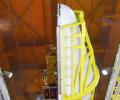
PSLV-C51/Amazonia-1 is the first dedicated commercial mission of NewSpace India Limited, Indian Space Research Organisation's commercial arm.

The US Air Force on Wednesday handed over NISAR, an earth observation satellite jointly developed by NASA and ISRO, to the Indian space agency.

Here's a breakdown of how the series of events unfolded at the Satish Dhawan Space Centre at Sriharikota

The space agency had earlier announced that the launch is tentatively scheduled at 09:28 hrs IST on November 25, subject to weather conditions.

The launch of Polar Satellite Launch Vehicle (PSLV-C52) is scheduled at 05:59 hours on Monday from the First Launch Pad of Satish Dhawan Space Centre, Sriharikota, the Bengaluru-headquartered space agency said.

The Indian Space Research Organisation (ISRO) on Thursday announced that its lunar mission Chandrayaan-3 will be launched on July 14 from the space port at Sriharikota in Andhra Pradesh.
For carrying the 360-kg Italian satellite, meant for astronomical studies, Indian Space Department's commercial wing Antrix Corporation would receive a fee from the Italian space agency.

The NASA-ISRO NISAR mission has entered its 90-day commissioning phase, involving rigorous checks and calibrations to prepare the satellite for Earth observation. Scientists highlight the collaborative benefits and technological advancements of the mission.

Skyroot Aerospace has become the first private company in India to give wings to the Indian space programme, after the sector was opened to private players by the Centre in 2020.

Indian Space Research Organisation's 101st mission from Sriharikota, an earth observation satellite onboard the agency's trusted Polar Satellite Launch Vehicle (PSLV) rocket, could not be accomplished on Sunday following a pressure issue in the third stage of the launch vehicle, the space agency said.
In a landmark journey into a new era of space application, India successfully launched its first dedicated navigation satellite using the Polar Satellite Launch Vehicle, which blasted off from the Satish Dhawan Space Centre in Sriharikota, Andhra Pradesh.
India on Monday successfully launched five foreign satellites from four countries on board PSLV-C23 rocket which placed them in orbit, an achievement described by Prime Minister Narendra Modi as an 'endorsement' of the country's space capabilities.

The primary satellite TeLEOS-2 is a synthetic aperture radar satellite developed under partnership between Defence Science and Technology Agency (DSTA) representing the Government of Singapore and ST Engineering.
The satellite was placed at 4.18 pm, a little over 17 minutes after the Geosynchronous Satellite Launch Vehicle (GSLV-F-01) carrying it was launched from the Satish Dhawan Space Centre in Sriharikota.
In a New Year gift to the nation, the Indian Space Research Organisation on Sunday successfully launched a Geosynchronous Satellite Launch Vehicle with an indigenous cryogenic engine from the spaceport of Satish Dhawan Space Centre in Sriharikota, entering a select club of nations.
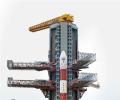
A 48-hour countdown began on Monday for the launch of record 20 satellites, including India's latest earth observation Cartosat-2 Series Satellite, onboard PSLV C-34 from Sriharikota on June 22.
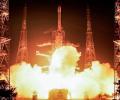
ISRO's vendor policy and quality control processes are under scanner.
The 51-hour countdown for India's landmark 100th space mission began on Friday with Indian Space Research Organisation's old warhorse Polar Satellite Launch Vehicle rocket all set to soar into space on September 9 with two foreign satellites from the spaceport of Sriharikota in Andhra Pradesh.
India's Polar Satellite Launch Vehicle on Wednesday successfully sent into orbit four satellites, including the Indo-French tropical weather satellite Megha-Tropiques.
Chandrayaan-4 will involve at least two separate launches of the heavylift LVM-3 rocket that will carry five different components of the mission which will be assembled in orbit.
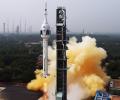
The test vehicle development flight (TV-D1) will be conducted at the Satish Dhawan Space Centre in Sriharikota in Andhra Pradesh to test the crew module that is scheduled to house Indian astronauts during the human spaceflight late next year.
ISRO has put out stunning photos of the launch of GSLV-D5. The vehicle smoothly lifted off to space from Sriharikota on Sunday afternoon and put India into the elite 'cryogenic club'.
